
PROBOS Perspective: People Don't Resist Change. They Resist What Change Threatens.

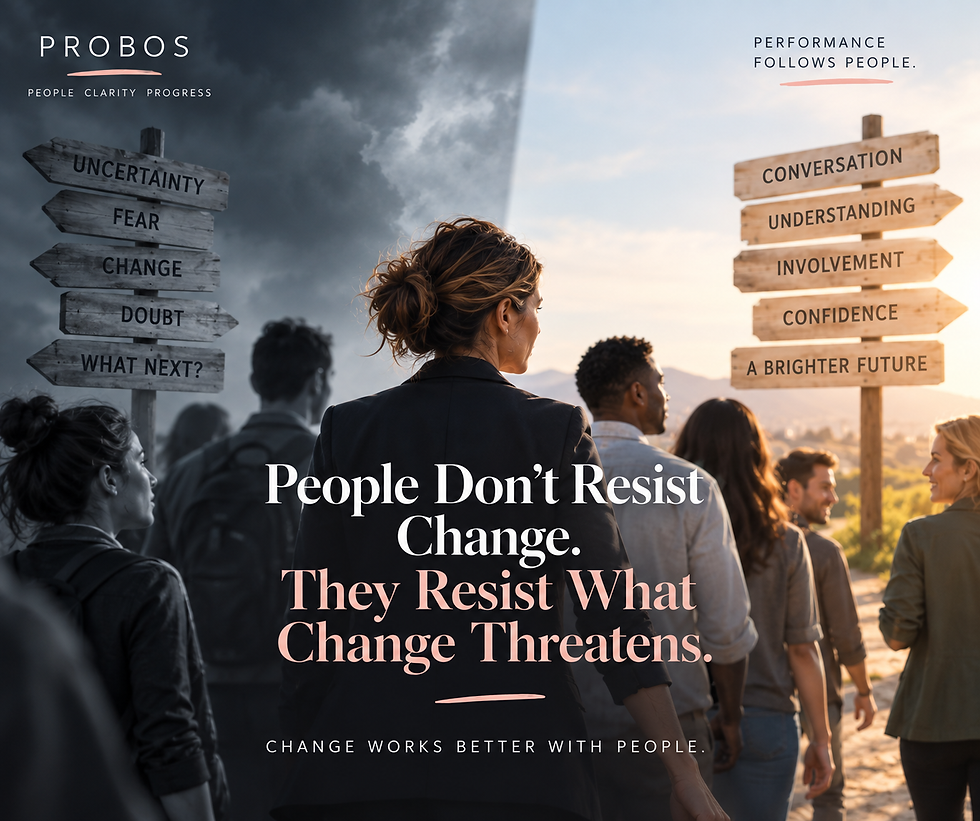
What if the resistance you're seeing isn't really resistance at all?
Organisations spend enormous amounts of time planning change: the strategy, the structure, the technology, the process, the timeline, the governance, the communication plan and then we announce it to people and wonder why they don't immediately get behind it.
Whilst organisations experience change through plans, milestones and deliverables, people experience change personally. They hear something very different. What does this mean for me?
Will I still have a job?
Will I still be good at my job?
Who will I report to?
Will my role change?
Will I lose influence?
What will happen to my team?
Can I trust what I'm being told?
Why are we doing this?
and probably the biggest one:
What am I going to lose?
That is why one of the most important things leaders can do during change is understand why people behave the way they do.
People Don't Resist Change. They Resist What Change Threatens.
It's very easy to label people as resistant :"They're just negative", "They don't like change.", "They're stuck in the past." and "We need them to get on board." but resistance is a behaviour.
The more interesting question is: What's underneath it?
For one person, change might threaten their sense of competence.
For another, status. For someone else, relationships, identity, control, certainty or belonging.
Someone who has spent ten years becoming the expert may suddenly feel like a beginner again.
Someone who built a successful team may see it being dismantled. Someone who had influence in the old organisation may not know where they fit in the new one. Someone who has experienced several transformations may simply be exhausted by yet another one.
Same change but completely different human experience.
If we label all of that resistance, we miss the opportunity to understand what's really happening.
When Change Feels Like Threat
There is another important human response leaders need to understand.
When our brain and nervous system perceive threat, we can move into familiar survival responses:
Fight. Flight. Freeze. We sometimes associate these responses with physical danger.
but the threat doesn't have to be physical. At work, change can threaten things that matter enormously to us: status, identity, competence, control, belonging, relationships, security, reputation or our sense of certainty about the future and fight, flight or freeze can look very different in an organisation:
Fight might look like challenging every decision, becoming defensive, angry, argumentative or increasingly controlling.
Flight might look like avoidance, withdrawal, disengagement, increased absence or quietly looking for another job.
Freeze might look like indecision, procrastination, silence, reduced contribution or simply not knowing what to do next.
Leaders see the behaviour and sometimes conclude: “They're resistant to change.”
but the more useful question is: “What is this change making them feel they need to protect?”
That doesn't mean every difficult behaviour should be excused. It means understanding what's driving it gives us a far better chance of leading it because human beings don't leave their nervous systems at the office door.
Your People Are Starting Where You Started Months Ago
This is one of the biggest mistakes I see leaders make during change. The senior team may have been discussing the transformation for six months. They've debated it, questioned it, worked through different scenarios, seen the data, understood the commercial rationale, had time to process what it means and then comes announcement day. The leader stands up and says:
“This is an exciting new chapter.” but for many people in the room, it isn't an exciting new chapter yet. It's Tuesday morning and they've just discovered their world is changing. The leadership team may be months into processing the change but everyone else may be on minute one.
That gap matters. Don't mistake your familiarity with the change for somebody else's readiness for it. People need time to make sense of what leaders may already have had months to process.
Communication Isn't Engagement
Organisations often say: "We've communicated the change." - There's been a town hall, a presentation, an email from the CEO, an FAQ document and / or a page on the intranet but communication isn't the same as understanding and understanding isn't the same as engagement.
People need opportunities to ask questions to challenge, hear things more than once, discuss what the change means for their team, to understand what it means for them personally and sometimes simply to say: “I'm worried about this.” That isn't necessarily negativity. It's processing.
The quality of change leadership isn't determined by how beautifully the announcement is delivered. It's determined by the conversations that happen afterwards.
Change Works Better When It's Done With People, Not To People
This is something we believe strongly at PROBOS. People don't necessarily need control over every decision, often that's simply not possible but they do need agency. There is a significant difference between: “This is happening to me.” and“I understand what's happening, why it's happening, what I can influence and what I need to do next.”
Good change leadership creates opportunities for people to contribute where contribution is genuinely possible, to ask questions, raise concerns, shape implementation, identify risks, suggest improvements, solve problems and take ownership because involvement changes the psychological experience of change. People stop simply being recipients of change and start becoming participants in it.
Leaders Are the Translators of Change
Senior leaders may design the strategy but managers make change real.
They are the people employees turn to and ask:
"What does this actually mean for us?"
"Is my job safe?"
"Why are we doing this?"
"Do you think this is going to work?"
"What aren't they telling us?"
and that puts enormous responsibility on managers. Too often we give managers a slide deck and expect them to lead people through uncertainty but change leadership requires much more than communicating information. Managers need to know how to listen, how to handle emotion, how to respond when they don't know the answer, how to create clarity when some uncertainty remains, how to recognise fight, flight or freeze responses without labelling people as difficult, how to challenge unhelpful behaviour without dismissing legitimate concerns, how to maintain trust, how to help people regain a sense of control and how to manage their own response to the change while supporting everybody else's. Managers aren't simply messengers of change.
They are translators of it.
Don't Rush People Through Change
People move through change differently. Some become excited quickly. Some need evidence.
Some need conversation. Some need time. Some become frustrated. Some initially withdraw.
Some question everything and sometimes leaders become impatient because they want people to move forward but emotion doesn't disappear because a project plan says we're now in Phase Two.
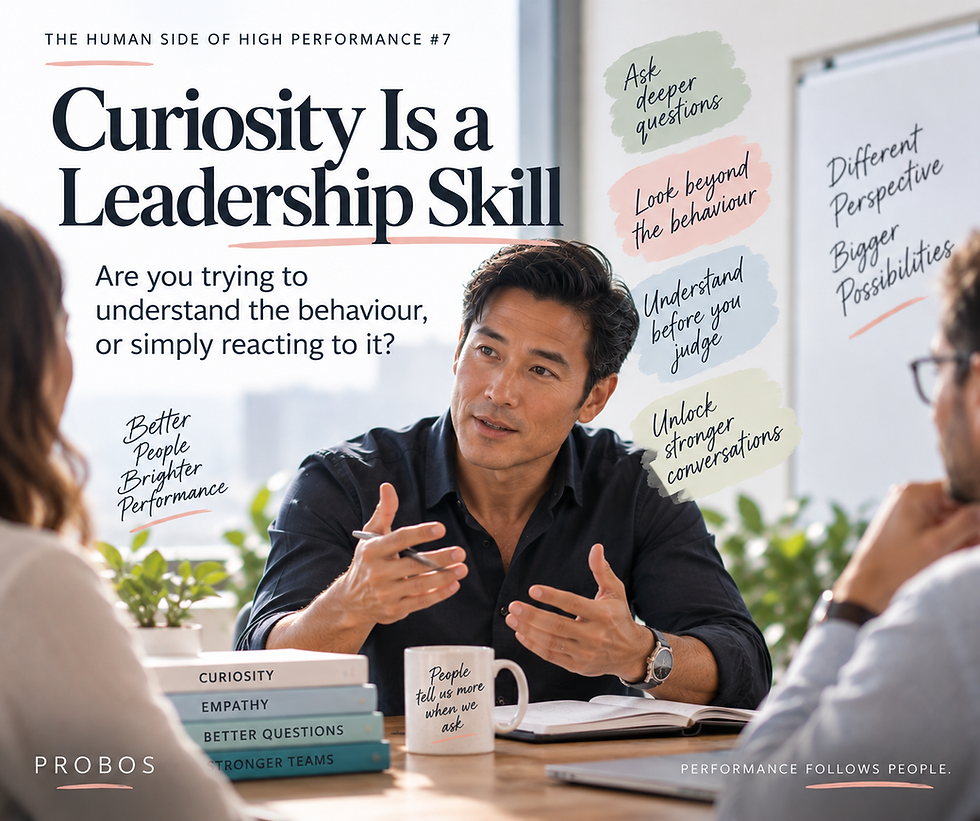
The role of the leader isn't to drag people through change faster. It's to understand where they are and help them take the next step. That requires curiosity.
What are you concerned about?
What feels unclear?
What do you feel you're losing?
What would help you move forward?
What do you need from me?
Sometimes one good conversation can tell you more about someone's response to change than another twenty slides.
Trust Becomes Even More Important When Certainty Disappears
During change, leaders won't always have the answers and people can usually cope with that.
What they struggle with is believing leaders have answers but aren't sharing them. That's where trust becomes critical:
Say what you know.
Say what you don't know.
Say what has been decided.
Say what hasn't.
And say when people can expect to hear more.
False certainty rarely creates confidence for long. Honest uncertainty is often more trustworthy than manufactured reassurance and when something changes, acknowledge it. People don't expect leaders to predict the future perfectly. They do expect them to be straight with them.
The PROBOS Perspective
At PROBOS, we believe successful change isn't simply about designing the right transformation.
It's about equipping leaders to bring people with them. That means helping leaders understand human responses to change.
Recognise what may sit underneath resistance.
Understand fight, flight and freeze responses.
Build trust.
Create clarity.
Have better conversations.
Listen properly.
Give people appropriate agency.
Challenge when necessary.
Help people move from uncertainty towards ownership.
However sophisticated the transformation plan might be, eventually it comes down to thousands of individual human decisions:
Do I understand this?
Do I trust it?
Do I believe in it?
Do I know what I need to do?
Am I willing to move?
Strategies change. Structures change. Systems change. Processes change but none of them create transformation on their own.
Organisations don't change. People do and .......change works better when it's done with people, not to people.
If your people appear to be resisting change, have you spent enough time understanding what the change may be threatening for them?
At PROBOS we believe leadership is not becoming simpler. But it can become clearer.
We help leaders navigate complexity with clarity and confidence.

Comments