
The Human Side of High Performance: Article 5

Updated: 4 days ago

Trust Is Built Before It's Needed
Why do some teams pull together under pressure while others pull apart?
I have always believed that trust is the single most important factor in any relationship, personal or professional. Without trust, almost everything becomes harder, communication, collaboration, challenge, delegation, change, accountability and performance.
Trust is an interesting thing. It can take months or years to build and moments to damage.
We tend to notice it most when it disappears- difficult decision is made, something goes wrong, performance drops, change is announced, someone makes a mistake and suddenly people start questioning motives.
"Why did they do that?"
"What aren't they telling us?"
"Can I say what I really think?"
"Is it safe to challenge this?"
But the interesting thing about trust is that it is incredibly difficult to create at the exact moment you desperately need it. Trust is built before it's needed through hundreds of seemingly insignificant interactions.
Doing what you said you would do.
Having the difficult conversation rather than avoiding it.
Admitting when you got something wrong.
Giving credit.
Listening properly.
Keeping confidences.
Being consistent.
Backing someone when it matters.
Saying "I don't know" when you don't.
None of these moments feels particularly significant at the time. Collectively, they become the relationship and eventually, the culture. Patrick Lencioni puts trust at the foundation of his Five Dysfunctions of a Team model for good reason.
Without trust, teams fear conflict.
When they fear conflict, they struggle to commit.
Without genuine commitment, accountability becomes difficult.
And ultimately, results suffer.
But Lencioni's definition of trust is particularly important as it is vulnerability based trust.
The ability to say:
"I got that wrong."
"I don't know."
"I need some help."
"You are better at this than I am."
"I disagree."
Those sentences sound simple and, in some organisations, they require enormous courage because people are constantly learning whether vulnerability is safe and that is where leadership matters. Every reaction teaches people something.
As a leader have you noticed :
When somebody brings you bad news, what happens?
When somebody challenges your thinking, what happens?
When somebody admits they don't know, what happens?
When somebody makes a genuine mistake, what happens?
People watch and they learn incredibly quickly. If honesty is punished, people become less honest. If challenge is interpreted as disloyalty, people stop challenging. If vulnerability is used against someone, people stop being vulnerable.
When trust is strong, something very different becomes possible; radical candour, the ability to care personally while challenging directly. To say what needs to be said without destroying the relationship in the process. This is where trust and high performance become inseparable because I can challenge you more directly when you know I have your best interests at heart. I can tell you: "That wasn't good enough.", "I think you've got this wrong.", "You're avoiding the difficult issue.", "I need more from you." And you can say exactly the same to me, not because the relationship is weak, but because it is strong enough to carry the conversation. That is an important distinction. High trust doesn't mean low challenge. In fact, I would argue the opposite. Trust creates the conditions for greater challenge.
Elite sport understands this incredibly well. Players need to know that the person beside them will do their job. That someone will cover when they make a mistake, feedback is intended to improve them, not undermine them, difficult conversations can happen without damaging the relationship, that when someone says, "I've got you," they mean it. You cannot manufacture that trust in the final five minutes of a game. It has been built in training, in preparation, in setbacks and in the conversations nobody else saw.
Business is no different but I think building trust has become harder. Many managers and leaders now lead people they see far less frequently in person. Remote and hybrid working have removed many of the small, informal interactions through which relationships were traditionally built:
The conversation walking back from a meeting.
The five minutes over coffee.
Noticing that someone seems quieter than usual.
The spontaneous: "How did that presentation go?"
The opportunity to see how someone responds when something goes wrong.
Those moments mattered and when they no longer happen naturally, leaders have to create connection more intentionally. This doesn't mean filling diaries with more Teams or Zoom calls.
More meetings don't automatically create more trust (and sometimes they create the opposite).
It means making the interactions we do have more human, turning the camera on and actually connecting, picking up the phone rather than sending another message, creating space in a one to one that isn't entirely transactional, just having a spontaneous virtual coffee and asking:
"How are you really doing?" and being interested enough to hear the answer.
Trust needs proximity. If not always physical proximity, then human proximity and I believe that's one of the biggest challenges facing leaders in increasingly remote organisations. We cannot assume relationships will look after themselves because low trust is expensive. Covey called 'lack of trust in a business' a tax and we see that demonstrated in organisations where people double / triple check, they copy people into emails to protect themselves, they hold back information, they avoid difficult conversations, they second guess decisions, they spend time managing politics, they hesitate, they protect territory, they say yes in the meeting and something very different afterwards. None of those behaviours appear on a balance sheet but they consume enormous amounts of organisational energy.
High trust changes the equation- people move faster, ask for help sooner, challenge ideas without attacking the person, admit mistakes before they become bigger ones, make decisions closer to the work and they spend less energy protecting themselves and more energy solving problems.
Perhaps that is why I believe trust is the foundation of every successful relationship, because without it, we manage ourselves around one another but with it, we can actually work together.
Performance follows people.
And people perform differently when they trust the people around them.
So perhaps the time to think about trust isn't when you're facing a crisis, transformation or difficult decision. It's today, in the ordinary conversations, the small promises, the reactions and in the moments nobody thinks will matter. Because eventually, they will.
If someone in your team needed to tell you something tomorrow that they knew you wouldn't want to hear, would they trust you enough to say it?
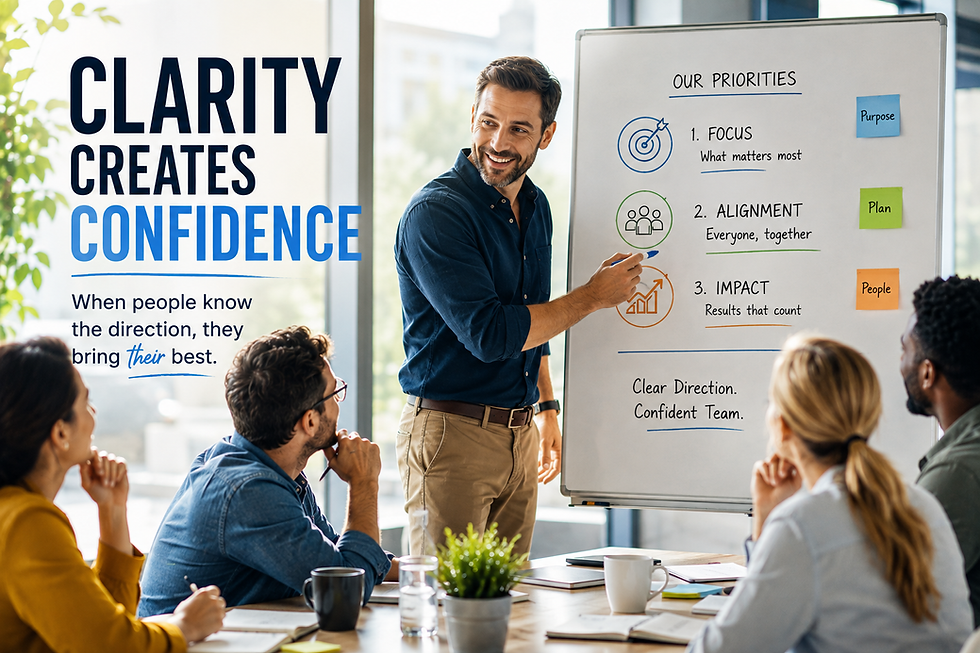
At PROBOS we believe leadership is not becoming simpler. But it can become clearer.
We help leaders navigate complexity with clarity and confidence.


Comments