
The Human Side of High Performance : Article 7

Updated: Sep 17
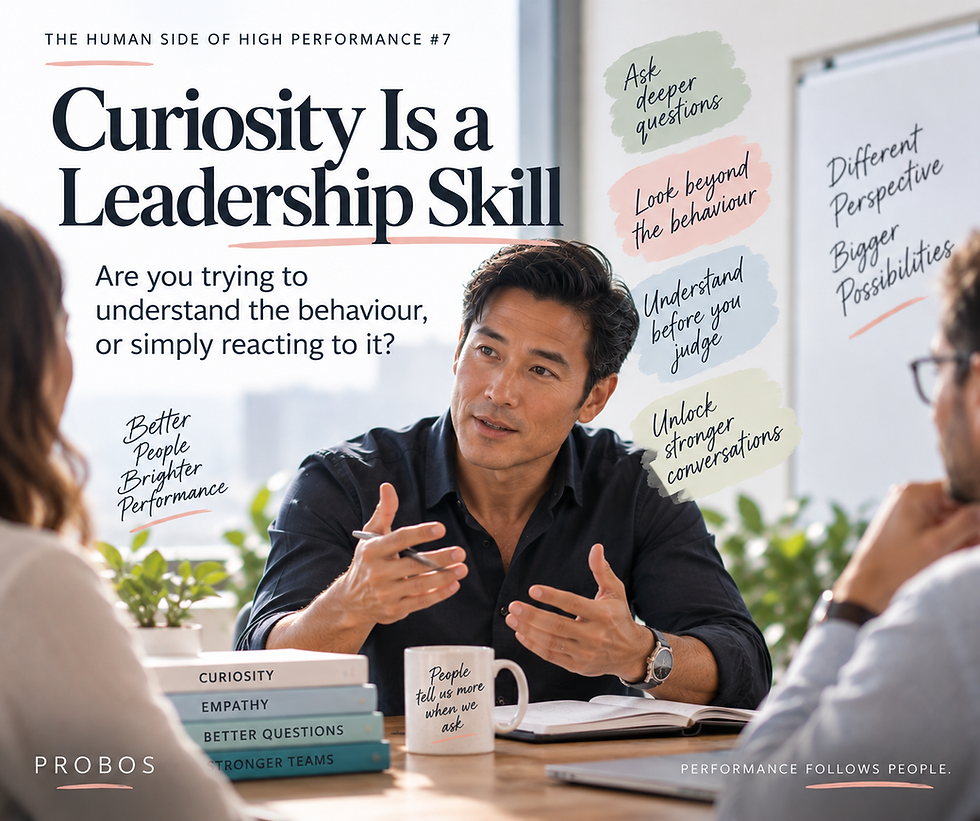
Curiosity Is a Leadership Skill
Are you trying to understand the behaviour, or simply reacting to it?
One of the phrases I probably use more than any other in my work is: “We need to understand why people behave the way they do.” because behaviour is what we see, but it is rarely the whole story.
Someone becomes defensive in a meeting, someone suddenly goes quiet, a previously engaged employee starts doing the bare minimum, a high performer becomes controlling, someone resists a change that seems perfectly logical or a colleague reacts disproportionately to something relatively small. It's very easy to label what we see- difficult, negative, disengaged, emotional, controlling 0r resistant. However, labels close conversations, curiosity opens them.
Behaviour Is Data
I've always believed that behaviour tells us something. The challenge is that we often jump straight from observing behaviour to interpreting intention. They didn't contribute, so they don't care, they challenged me, so they're being difficult, they're questioning the change, so they're resistant or they're checking everything, so they don't trust their team. Maybe, but maybe not.
What if the person who isn't contributing doesn't feel safe enough to speak?
What if the person questioning the change is worried about something nobody has addressed?
What if the leader checking everything is frightened of failing?
What if the person who appears disengaged is completely overwhelmed?
Same behaviour. Very different story. That's why curiosity matters.
Curiosity Before Judgement
Leadership gets harder when we're under pressure. We want answers, we want decisions, we want things fixed and curiosity can feel slower than judgement but judgement based on the wrong assumption often costs far more time later. A simple question can completely change a conversation.
“Help me understand what's happening for you.”
“What am I missing?”
“What concerns you most about this?”
“What would make this easier?”
“What's behind that reaction?”
Not interrogation, not amateur psychology, just genuine curiosity because sometimes the most powerful thing a leader can do is resist the temptation to already know the answer.
Curiosity Beats Certainty
The more senior we become, the easier it is to believe we're supposed to have the answers. People look to us for direction and experience gives us pattern recognition. We've seen similar situations before and that's useful until experience becomes certainty.
"I know what the problem is."
"I've seen this before."
"I know how they'll react."
"I know what motivates them."
However, people aren't spreadsheets. The same person can behave differently on different days because the context has changed.
Pressure changes us.
Confidence changes us.
Relationships change us.
Fear changes us.
Feeling valued changes us.
Feeling excluded changes us.
Great leaders bring experience to a situation without allowing experience to stop them being curious. Expertise gives us hypotheses. Curiosity tests them.
People Don't Always Resist Change. Sometimes They Resist Threat.
This becomes particularly important during change. Leaders often describe people as resistant but resistance is behaviour. The more useful question is: What is the person protecting?
Status? Competence? Relationships? Identity? Control? Certainty? Belonging? Their reputation?
Their job? What looks like resistance can sometimes be a perfectly human response to perceived threat. That doesn't mean leaders abandon the change, i means they understand what they're asking people to navigate because once we understand what's underneath the behaviour, we can lead it far more effectively.
Curiosity Doesn't Remove Accountability
This is where it connects directly to the last article. Understanding behaviour doesn't mean excusing it. There is an important difference between:
“I understand why you behaved that way.” and “Therefore that behaviour is acceptable.”
Both things can be true: "I understand what drove this."and: "We still need to address what happened."
Curiosity helps us have a better accountability conversation because we're responding to the real issue rather than our assumption about it.
Understand first. Then challenge. Then coach.
Ask One More Question
One of the simplest habits I've encouraged leaders to develop is this: Before reaching a conclusion about someone's behaviour, ask one more question:
When you think they're disengaged, ask.
When you think they're resistant, ask.
When you think they lack confidence, ask.
When you think they're being difficult, ask.
When you're absolutely convinced you know why they did something... especially then, ask.
You might still reach exactly the same conclusion but sometimes you'll discover something completely different and that discovery can change how you lead the person in front of you.
Understanding People Is a Performance Skill
This is why I don't see curiosity as simply a "soft" leadership skill, it's a performance skill.
If you understand what motivates people, you can engage them.
If you understand what threatens them, you can lead change more effectively.
If you understand what gives them confidence, you can help them grow.
If you understand what's driving difficult behaviour, you can address the cause rather than repeatedly managing the symptom.
If you understand people better, you make better leadership decisions.
Performance follows people.
And if we want to understand performance, sometimes we have to look beyond what people are doing and become curious about why they're doing it.
Whose behaviour have you already formed an opinion about, when what you might actually need is one more question?
At PROBOS we believe leadership is not becoming simpler. But it can become clearer.
We help leaders navigate complexity with clarity and confidence.



Comments